Home
Our Story: The Roots of This Framework
Welcome to the Core to Crowns, a transformative psychological framework designed to enhance work effectiveness for practitioners in Psychology, Coaching, and Human Resources.
Whether you guide individuals or cultivate organizational well-being, we invite you to journey with us from roots to crowns.
Please start scrolling and enjoy the scrollytelling.

The Founder’s Story
Hanny’s journey begins with her grounding in Industrial-Organizational (I/O) Psychology and Adlerian Psychology.
Alfred Adler posited that humans are not merely a collection of drives (id, ego, superego) but are holistic, goal-oriented beings striving for significance within a social context.
Hanny resonated with the idea that mental health is intrinsically linked to one’s connection to the community. However, in her I/O practice, she observed a gap. They understood they should connect, but their nervous systems were wired for protection and isolation.
The Narrative Encounter: The Tree of Life
Searching for a tool to externalize these internal conflicts, Hanny encountered the Tree of Life methodology, co-developed by
Ncazelo Ncube-Mlilo and David Denborough.
This narrative therapy approach used the tree metaphor to allow participants to tell “second stories”, narratives of strength and resilience rather than just trauma.
Hanny was struck by the power of the metaphor:
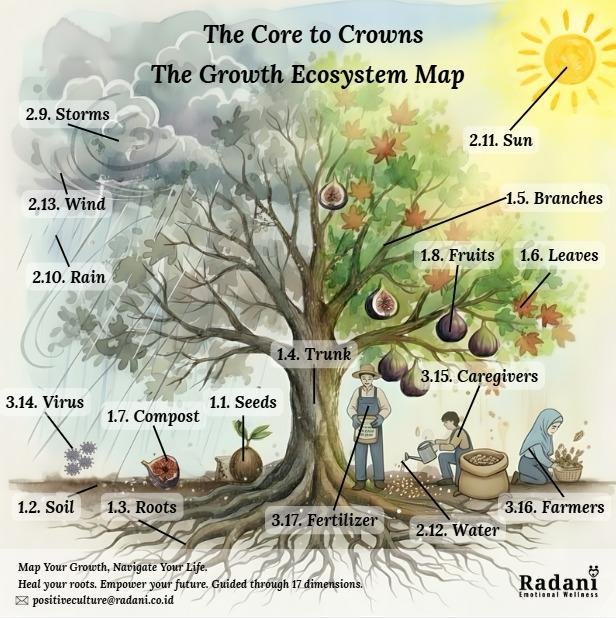
● Roots: Where we come from (heritage).
● Trunk: Skills and values.
● Branches: Hopes and dreams.
● Leaves: Significant relationships.
● Fruits: Gifts given and received.8
However, her research phase revealed a limitation when applying this to complex adult psychology in high-stakes environments.
The traditional Tree of Life focus is primarily narrative and celebratory. It is designed to “thicken the preferred story.”
While transformative, it did not explicitly map the nociceptive (pain-processing) root systems or the systemic entanglements that Hanny saw holding her clients (she calls them her partners) back.
She needed a tool that could hold space for the “Storms” not just as external events, but as internal, inherited biological realities.
The ‘Aha’ Moment: The Invisible Ceiling
The breakthrough came during Hanny’s work with the Systemic Family Constellations. She realized that the “Invisible Ceiling” her clients hit, burnout, self-sabotage, an imposter syndrome, was rarely a failure of skill (The Branch).
It was almost always a “loyalty” to an ancestral pattern (The Root). She saw that the performance of the professional (I/O Psychology) was being sabotaged by the unresolved trauma of the person (Somatic/Systemic).
The ‘Aha’ moment was the realization that the Tree needed to be an X-Ray.
It wasn’t enough to draw a pretty tree of strengths; practitioners needed to map the bioluminescent network of the roots to see why the tree wasn’t bearing fruit.
This required synthesizing the structural rigor of I/O psychology with the depth of Systemic Constellations and the accessibility of the Tree of Life metaphor.
The “Core to Crowns” was born not as a rejection of these disciplines, but as their integration.
It integrates the Holism of Adler, the Visual Narrative of the Tree of Life, and the Intergenerational Laws of Constellations, grounding them in Polyvagal Theory (safety/regulation).
The “Core to Crowns” was born with the mission “To equip the next generation of healers with a ‘biological blueprint’, a framework that honors the invisible roots of trauma while architecting the visible crowns of legacy.
We do not just prune the leaves; we map the ecosystem.

The Need
Why Even Successful Practitioners Hit Invisible Ceilings
1. The Cognitive Bypass
Traditional modalities often over-rely on the prefrontal cortex (logic, language, strategy).
Clients can articulate their problems perfectly (“I have a fear of abandonment”), yet the pattern persists. This is because the pattern lives in the limbic system and brainstem (the Somatic Root), which language cannot reach
2. The "Band-Aid" on the Branch
Many tools focus on behavioral modification (pruning the branch) without addressing the systemic source (the root).
We validate the practitioner’s fatigue in trying to “fix” behaviors that are continuously fed by invisible root systems.
3. The Lack of a Shared Map
Without a visual externalization tool, the client and practitioner often navigate different mental maps.
The Gap
For every 0 people in need worldwide, there are, on average, only 0 mental health professionals.
In many countries, that number drops to 0.
This isn’t a shortage — it’s a systemic collapse. Even if every person with a clinical disorder wanted help, the system could only reach a fraction of them.
The Opportunity
The Business Case for the “Tree” Metaphor
We are not here to replace psychiatrists or therapists. We are here to build a new frontline to meet the millions in the ‘grey area’ who are suffering but will never access clinical care.
With a coaching framework grounded in science, we can provide emotional scaffolding, nervous system support, and purpose-building that the current system simply cannot deliver.
The Core to Crowns framework allows a practitioner to serve a client through the entire lifecycle of growth, i.e.
1. The Root Level (Therapy/Healing)
Use the “Ancestral Soil” and “Nociceptive Root” tools to process deep trauma and systemic blocks. (High-touch, high-trust work).
2. The Trunk Level (Coaching/Building)
Use the “Personality Strength Map” and “Growth Navigator” to build character, resilience, and operational capacity.
3. The Crown Level (Consulting/Vision)
Use the “Virtues Navigator” for leadership visioning, legacy planning, and strategic contribution.
The Benefit
The practitioner doesn’t have to refer the client out when they shift from “healing” to “growing.” The framework scales with the client.
Scalable Structure: The Fractal Nature
The “Tree” metaphor is fractal; it applies to an individual, a family, a team, or an entire organization.
For HR Leaders
You are trying to fix a Forest (The Company) by painting the Leaves (Perks/Benefits).
You need to test the Soil (Culture) and treat the Roots (Systemic Safety).
This is not just a certification. It’s a calling to serve where the need is greatest.
Some may ask: ‘Is coaching really evidence-based?’ Let me share what the research says:
- Studies in The Journal of Positive Psychology show that strength-based coaching increases well-being and reduces depressive symptoms.
- Research in Frontiers in Psychology confirms that coaching builds psychological capital, hope, resilience, and optimism.
- A landmark study in Psychology Research and Behavior Management found that life coaching significantly reduces anxiety and depression while enhancing goal attainment.
This is why Core to Crowns is not just philosophical, it’s scientific.
It integrates polyvagal theory, positive psychology, and strengths-based coaching into a structured pathway that’s proven to work.